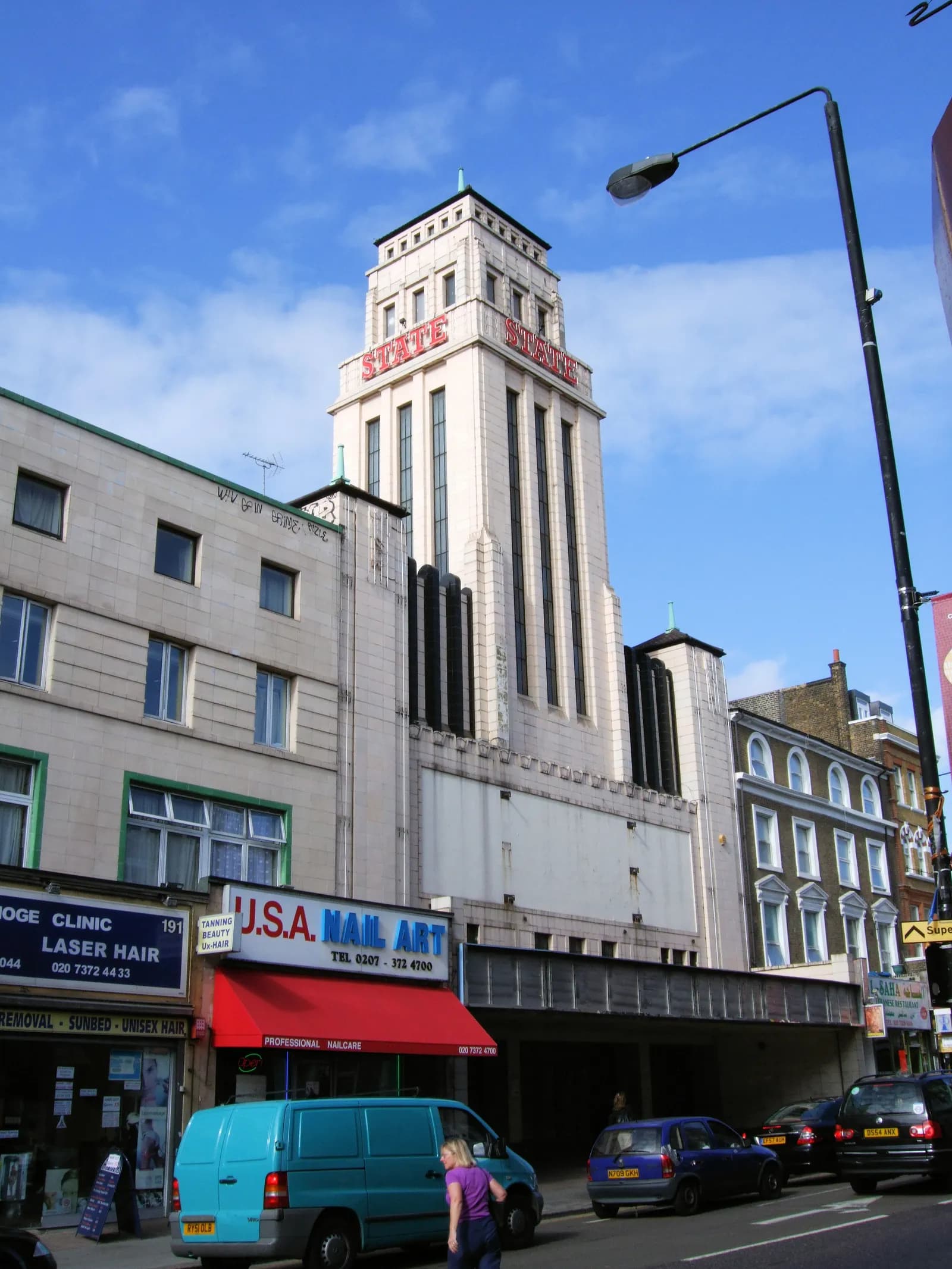
The Gaumont State Cinema has dominated Kilburn High Road for nearly ninety years, its 120-foot tower visible for miles across the London Borough of Brent. From its 1937 opening as one of Europe's largest cinemas to its current role as a place of worship, the building remains a landmark of architectural ambition and cultural significance.
An Empire State Vision on the High Road
The Gaumont State Cinema opened on 20 December 1937, the creation of architect George Coles and builders the Hyams brothers. The name "State" derived from its 120-foot tower, deliberately styled after the Empire State Building in New York. Covered in cream ceramic tiles and bearing the word "STATE" in large red neon letters, the tower transformed Kilburn's skyline and remains visible from considerable distances across Brent today.
Coles designed the building in an Art Deco Italian Renaissance style, combining American skyscraper aesthetics with European grandeur. The exterior's clean geometric lines concealed an opulent interior finished in salmon, turquoise, and gilt. With seating for 4,004 people, plus standing room for a further 4,000, it was among the largest cinemas ever constructed in England.
A Palace of Italian Renaissance Splendour
The foyer set the tone for visitors' experiences. A double staircase of Italian marble wound upwards to the Round Lounge, whilst overhead hung chandeliers modelled on those at Buckingham Palace. The main fixture contained 125 lamps and 8,000 pieces of crystal; its royal counterpart at the palace holds merely 80 lamps. Such extravagance announced that working-class Kilburn deserved the same grandeur as Westminster.
The auditorium itself featured a gold and green domed ceiling above a stage measuring 100 feet wide and 50 feet deep. Twenty dressing rooms and a scenery workshop supported live performances, whilst an orchestra pit on a hydraulic lift could rise to stage level. The complex also included a 400-seat restaurant with a separate entrance on Willesden Lane and, remarkably, a row of dancing fountains for floor and stage shows.
The Mighty Wurlitzer
At the heart of the Gaumont State stood its 4-manual, 16-rank Wurlitzer organ, one of the largest ever installed in a British cinema. Costing £28,000 in 1937 (approximately £800,000 today), the instrument comprised 1,200 pipes ranging from one inch to 32 feet in length. Some 2,000 electro-pneumatic motors and 1,100 miles of electric cable powered the organ, supported by a 15-horsepower generator.
The console sat on a revolving lift with three possible positions: facing front, facing backwards and revolving to face the audience, or facing front then turning backwards. Sidney Torch served as the original organist, earning £250 per week when the average wage stood at £2 or £3. His understudy, Luis Mordish, later became pianist at the Palm Court of the Grosvenor House Hotel.
The Wurlitzer remains one of the largest fully functioning cinema organs in Britain and one of few still in its original location. David Neale, who began work at the cinema in August 1959 as a rewind boy and became house engineer in 1980, continues to maintain the instrument today.
Opening Night and a Star-Studded History
The Gaumont State's opening night on 20 December 1937 was broadcast live on BBC Radio. Gracie Fields, Larry Adler, George Formby, Henry Hall and his Orchestra, Carroll Levis, Vic Oliver, and Sidney Torch at the Wurlitzer performed before the cinema's first film screenings began on 27 December: Shirley Temple in Wee Willie Winkie and Jed Prouty in Big Business.
The venue quickly established itself as a major stop on the touring circuit. Frank Sinatra appeared on 21 June 1953. Buddy Holly played on 2 March 1958, followed by Jerry Lee Lewis on 25 May 1958 and Duke Ellington on 25 October 1958. The Beatles performed twice: 9 April 1963 and 23 October 1964. The Rolling Stones appeared on 19 November 1963. David Bowie performed on 13 June 1973; Deep Purple on 22 May 1974; Black Sabbath on 21 November 1975. The Who recorded their concert on 15 December 1977 for the film The Who at Kilburn: 1977.
Jazz musicians found particular favour at the Gaumont State. Django Reinhardt and Stéphane Grappelli appeared in 1938 and 1939. Ella Fitzgerald and the Oscar Peterson Trio performed on 11 April 1965. John Coltrane, Dizzy Gillespie, Thelonious Monk, Art Blakey, and Lee Morgan all played the venue between 1961 and 1965. Count Basie, Louis Armstrong, Sarah Vaughan, Harry Belafonte, Tom Jones, and Bill Haley and His Comets also graced the stage.
Cinema, Ballroom, and Bingo
The Gaumont State closed temporarily in October 1940 due to wartime conditions, reopening in November 1940 for weekend screenings only. The tower, taller than any local building, was camouflaged during the conflict. Queen Mary, mother of King George VI, regularly attended matinee performances, preferring the cinema to West End alternatives.
In January 1960, the main auditorium cinema closed for conversion of the rear stalls into a ballroom. The front stalls and balcony continued showing films with reduced capacity of approximately 2,042 seats. A second screen with 202 seats opened in the former restaurant on 23 November 1975. The main cinema closed permanently on 18 September 1980; the second screen followed on 10 October 1981.
The building operated as Mecca Bingo from the 1980s until 19 August 2007. During this period, David Neale maintained both the building and the Wurlitzer, ensuring the organ remained playable whilst the cinema served other purposes.
A New Chapter for Kilburn's Landmark
When Mecca Bingo closed in August 2007, the building was put up for sale. Local residents launched the "Save the Kilburn State!" campaign to prevent unsympathetic development. In December 2007, exactly seventy years after the original opening, Ruach City Church acquired the building. Led by Bishop John Anthony Francis and Co-Pastor Penny Francis, the church reopened the venue on 10 July 2010 after restoration work.
The Grade II* listed building continues under ecclesiastical ownership today. On 6 November 2025, the Royal Philharmonic Orchestra performed to an audience of over 2,000 people, the first concert in the main auditorium since 1978.
Kilburn's Cultural Anchor
The Gaumont State stands at 197–199 Kilburn High Road in the London Borough of Brent, postcode NW6 7HY. It serves as a dominant visual feature of Kilburn's skyline and a reminder of the area's cultural vitality. Kilburn possesses London's highest Irish population alongside significant Afro-Caribbean, Indian, Bangladeshi, Pakistani, Eritrean, and Ethiopian communities. The cinema, alongside The Kiln Theatre (formerly the Tricycle Theatre), represents the high road's enduring role as a cultural hub for Brent's diverse residents.
From Gracie Fields to The Beatles, from the Wurlitzer's soaring tones to the Royal Philharmonic Orchestra, the Gaumont State Cinema remains Kilburn's Art Deco palace: a monument to architectural ambition, musical history, and the enduring spirit of northwest London.