The body of water straddling Brent and Barnet has served as a Victorian pleasure ground, a secret military testing site, and now a protected nature reserve. Its transformation mirrors the changing character of north-west London across two centuries.
Construction and Naming Controversy
Brent Reservoir, more commonly known as the Welsh Harp, was constructed between 1834 and 1835 to supply water to the Regent's Canal at Paddington. The contractor William Hoof completed the work for £2,740 under engineer James Morgan, an assistant to the renowned architect John Nash. The dam head collapsed in January 1841 following seven days of rain, killing two people.
The name "Welsh Harp" has sparked historical debate. A coaching inn called the Harp and Horn stood on the site from 1751, renamed the Welsh Harp by 1803, predating the reservoir itself. The Old Welsh Harp Tavern, built in 1859 on the site of the earlier inn, gave its name to the reservoir, which became commonly known as the Welsh Harp from the mid-19th century. The tavern was demolished in 1971 to make way for Staples Corner and the M1 motorway, but the name persists.
The Warner Era: Victorian Entertainment Hub
William Perkins Warner, a Crimean War veteran, became licensee of the Old Welsh Harp Tavern in 1858 and transformed the area into one of London's most popular pleasure gardens. He operated the attraction for 40 years until his death in 1899, creating what music hall star Annie Adams celebrated as "The Jolliest Place That's Out."
Warner's enterprise offered a remarkable range of attractions. Visitors could fish and hire boats on the reservoir, attend boxing matches, and enjoy pigeon- and duck-shooting. A race track operated until Parliament banned it in 1879. The site hosted the first greyhound races with mechanical hares in 1876 and the first formal cycle race on 1 June 1868, won by Arthur Markham. A menagerie included a bear that escaped during the Victorian heyday.
The Welsh Harp railway station opened in 1870 on the Midland Railway's Bedford to St Pancras line, bringing thousands of day-trippers on special bank holiday trains. At its peak in the 1880s, crowds exceeded 25,000 on bank holiday weekends. The station closed in 1903 as the area's popularity declined, partly due to the West Hendon development between 1895 and 1915.
Secret Military Testing Ground
From 1916, the Mechanical Warfare Department of the War Office, based in nearby Cricklewood, used fields between the reservoir and Dollis Hill for secret tests of a revolutionary new weapon: the tank. The Welsh Harp became the testing ground for the Mark IX, the world's first specialised armoured personnel carrier, designed by Lieutenant G.J. Rackham and built by Marshall, Sons & Co.
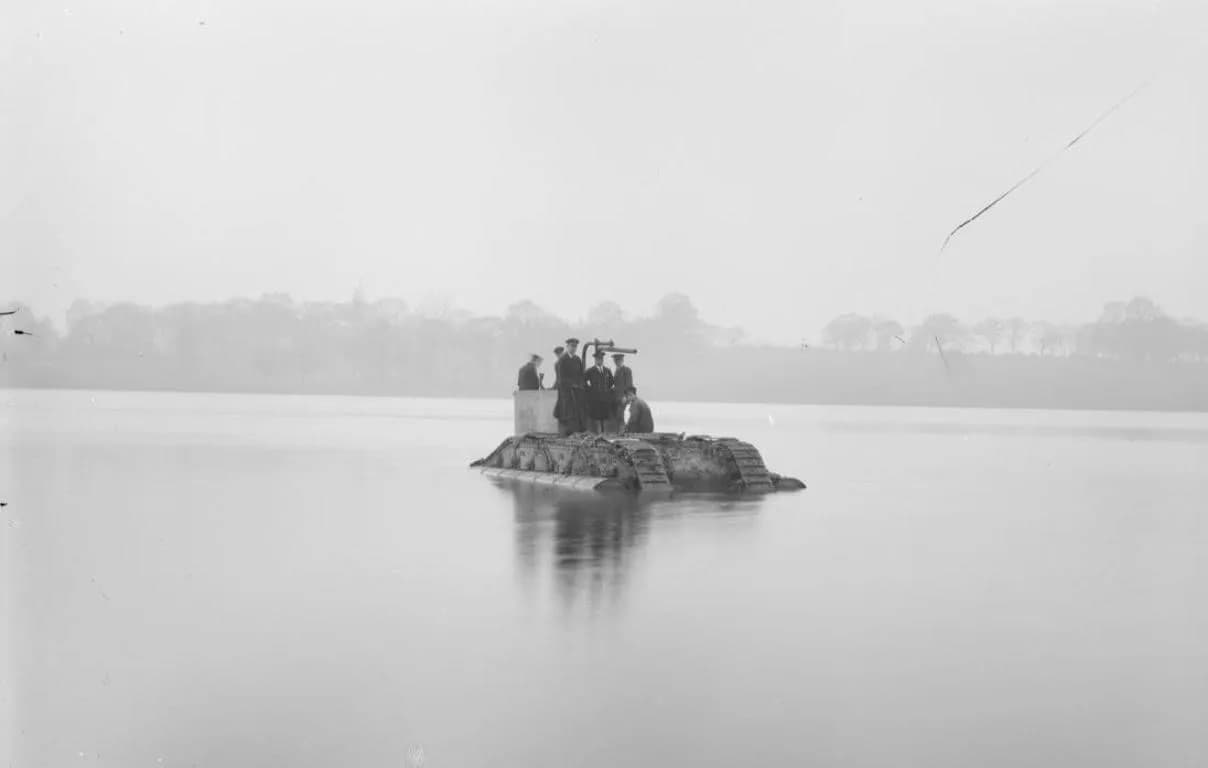
One Mark IX was converted into the world's first amphibious tank, nicknamed "The Duck." Photographs dated 11 November 1918, Armistice Day, show the floating tank on the reservoir, manned by Navy personnel. The tank staff were based at Dollis Hill.
During the Second World War, a seaplane was kept on the reservoir, rumoured to be part of an escape route for Winston Churchill and senior figures from the secret Paddock bunker beneath the Post Office Research Station at Dollis Hill. The bunker, codenamed "Paddock," was built in 1939 and used for only two Cabinet meetings before being abandoned in 1944.
Conservation and Modern Use
Today the Welsh Harp is designated as a Site of Special Scientific Interest (SSSI), notified in 1985. Covering 68.6 hectares, it is the only SSSI in either the London Borough of Brent or the London Borough of Barnet. The reservoir is also a Local Nature Reserve and a Site of Metropolitan Importance for Nature Conservation.
The Welsh Harp Conservation Group, founded in 1972, works to protect the natural environment and has successfully resisted development proposals, including plans for a golf course and driving range. The group has documented 253 bird species at the site, which was once second only to Rutland Water for breeding great crested grebe pairs in the UK. Other wildlife includes 31 butterfly species, 15 dragonfly and damselfly species, and 22 bat species.
The reservoir supports several water sports clubs, including Welsh Harp Sailing Club, Wembley Sailing Club, the Sea Cadets, and the University of London Sailing Club. The Phoenix Canoe Club and Outdoor Centre offers canoeing, kayaking, and other activities. The site hosted the 1960 Women's European Rowing Championships, which drew 200 competitors and 5,000 spectators and was televised by the BBC and Eurovision.
The reservoir borders Neasden to the south, Kingsbury Green to the west, West Hendon to the east, and Cricklewood to the north-east. It lies adjacent to the A406 North Circular Road and the A5 Edgware Road, a short distance north-east of Wembley Stadium.
What is confirmed: The Welsh Harp was constructed in 1834-35; William Warner operated pleasure gardens from 1858-99; the Mechanical Warfare Department tested tanks from 1916; the Mark IX amphibious conversion was tested on the reservoir; the site is an SSSI notified in 1985.